
The Good Advice That The DMV Rejected
If you’re driving a car, that car almost always has a license plate — a unique identifier that allows other drivers and the authorities to distinguish your car from other vehicles. Typically, the plates have either a random or sequentially issued series of numbers and letters, and don’t have any meaning unto themselves. But in most of the United States and Canada, for a fee, you can ask your state department of motor vehicles (the DMV) to give you a special one — one that has a message on it. “LETS GO METS,” “NCC-1701,” and this very creative “ETALLIC” one are examples of things the DMV will let you have.
Not everything will fly, though — sometimes, the DMV will reject your request. Messages that are overtly political or sexual in nature typically get rejected outright (although I once did see a Pennsylvania-issued plate that absolutely should not have been… it involved Roman numerals, if you want to guess). Ones that involve violence — even if unintentionally so — typically suffer the same fate, as a father of two boys named Kyle and Sean learned a few years back. Makes sense — you don’t want tags like that being seen on city streets.
But what about this? Is it good advice… or too toilet-focused to pass muster?
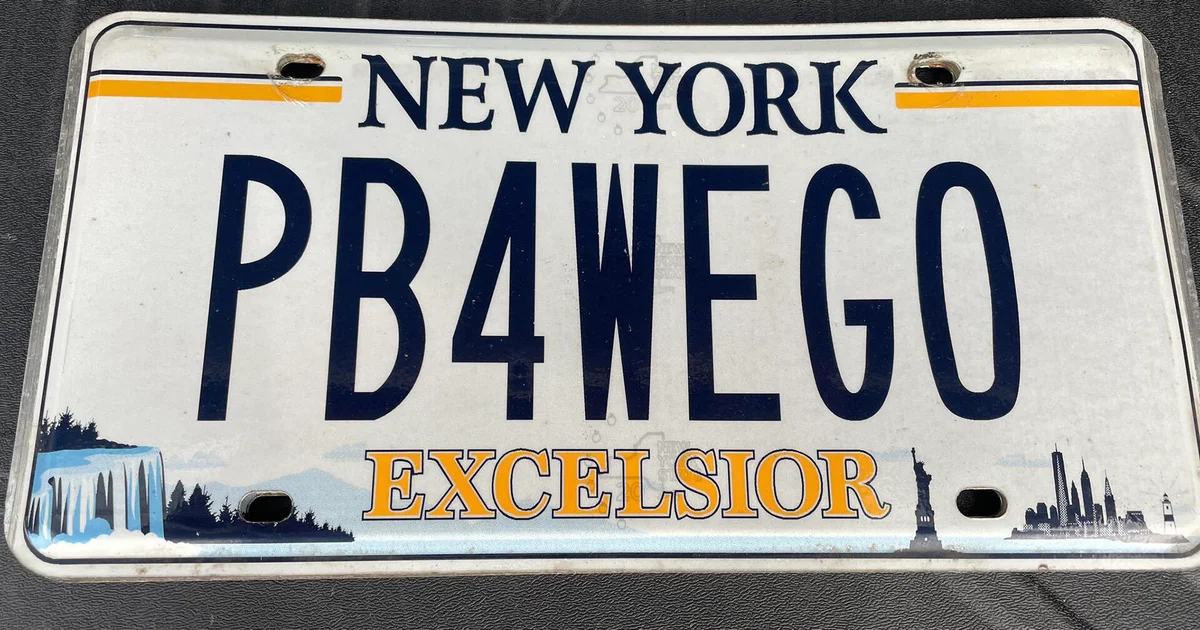
Get it? No? Let’s explain. If you’ve ever traveled with kids, you know the drill. You’re about to pull out of the driveway — or worse, you’re already fifteen minutes down the highway — when someone in the backseat announces they need a bathroom. It’s a parenting rite of passage, one that has spawned a universal pre-departure mantra: pee before we go.
Seth Bykofsky, a 69-year-old grandfather from Long Island, New York, decided to immortalize this wisdom on his license plate. For five years, his car bore the custom tag “PB4WEGO,” above, a lighthearted reminder visible to every driver stuck behind him at a red light. According to Bykofsky, the plate earned him smiles, thumbs-ups, and knowing nods from fellow parents and grandparents across the state. It was, by all accounts, harmless dad-joke territory.
Then, in January 2026, the New York State Department of Motor Vehicles sent him a letter. As CBS News reported, the DMV informed Bykofsky that his plate had been deemed “objectionable” and that he “must destroy” it, replacing it with standard-issue plates. The DMV cited regulations prohibiting plates considered “derogatory, contemptuous, degrading, disrespectful, or inflammatory.”
Bykofsky was, shall we say, peeved. (Sorry.) He took to social media to make his case, saying, “Is this simple plea… an incitement to riot? Have we inflamed the very soul of toddlers everywhere, struggling, against all odds, to hold it in?” He even jokingly announced a gubernatorial campaign with the pledge “A P On Every Plate,” warning that if the state could come for his license plate, they could come for anyone’s.
The story caught the attention of Governor Kathy Hochul, who apparently shares Bykofsky’s sense of humor. She didn’t just issue a statement — she called him personally. In a video she posted to social media, Hochul told Bykofsky she had read about his “plight” and loved the plate. “I’m going to get it back for you,” she said. “I think everyone should be reminded to pee before you go. I have kids and grandkids, and I support the effort wholeheartedly.” She called the plate a “public service.”
Amazingly, this isn’t the first time this exact license plate caused the same problem — with the same solution. In 2019, a New Hampshire mom also had a license plate reading “PB4WEGO,” and had for fifteen years, when her DMV suddenly made the same decision: she needed to turn the plates in because they were now deemed offensive. But ultimately, she was able to keep the plates; again, her governor intervened.
How the other 48 states will react has, as of yet, gone unreported. But regardless, the plates give good advice, and the drivers — and the governors, too, I guess — should be lauded for their efforts to keep long drives with kids a little less cumbersome.
Bonus fact: Before 1928, state license plates were boring — just numbers and letters, the state name, and not much else. But that year, Idaho decided to turn its plates into an ad for the state’s biggest claim to fame and cash crop — potatoes. As seen here, Idaho plates placed the number inside an image of an elongated potato, above the phrase “Idaho Potatoes.” Other states followed suit with stylized plates soon thereafter.
From the Archives: The Lucky License Plate That Wasn’t: A vanity plate that turned into a headache.