
A Date with Destiny
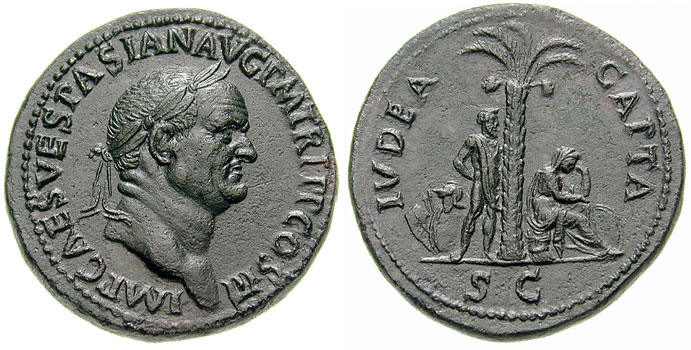
The last sighting of a dodo bird was in 1662. It is probably the quintessential example of an extinct species. The dodo is long gone, dead — never to return. And in general, that is what “extinct” means. But sometimes, an exception occurs — such is the case of the Judean date palm.
The Judean Desert extends, roughly, from Jerusalem to the Dead Sea. As the name implies, not a lot of flora grow in the area. But up until about 1,500 to 2,000 years ago, a tree called the Judean date palm was generally plentiful in the area. The tree, which became the symbol of the region roughly 2,500 to 3,000 years ago, provided fruit (dates) to the people in the area as well as shade and shelter. When the Romans captured the region and destroyed the second Jewish Temple in the year 70, the Roman emperor Vespasian minted a coin called the “Judaea Capta,” seen above. The back of the Capta depicts a Judean date palm, demonstrating how prevalent the tree was in the area.
Yet soon after it vanished. Exports of the dates ended under Roman rule, and sometime before the year 500 the Judean date palm disappeared from the area — and, therefore, the world.
The tree would have been lost forever but for one thing. An early Roman ruler of the area, Herod the Great, built a fortress on top of a mesa called Masada about a century before the destruction of the Second Temple. Masada still exists today (and, in fact, is one of Israel’s top tourists attractions). In the mid-1960s, excavators working on the site found some seeds well preserved in ancient pottery. Using carbon-dating techniques, researchers determined that the seeds were 1,900 to 2,000 years old. They kept the seeds in storage for forty years until they could plant them with reasonable success of germination, and in 2005, did exactly that. The seeds were placed in a special, hormone-infused soil.
Eight weeks later, one of the seeds sprouted. By 2010, the young tree had reached a height of two meters tall, and the Judean date palm returned from the land of the dodo. As of 2013, the tree — male — lives on a kibbutz in southern Israel. Plans are being made to mate it with a female tree of another species, in hopes of developing fruit by the mid-2020s.
Bonus fact: Over the past few decades, China has taken many steps to protect existing forests while encouraging the planting of new trees. In 1999, for example, the government banned the cutting down of trees in natural forests, and, in 2010, China invested more than $8 billion annually in planting new trees. It is one of two nations that have had a net gain in the number of trees thus far in the (admittedly young) twenty-first century (as of 2013). The other? Israel. The mostly desert landscape now has 240 million trees, according to the Jewish National Fund, which coordinates tree planting throughout the country, allowing anyone (even people outside of Israel) to fund the planting of a tree — one for $18 or three for $36.
From the Archives: Super Seed Bank: The building that helps prevent the eradication of plant species.