
The Worst 2.6% of the Planet?
“Why did the chicken cross the road?” is a set-up to an age old joke that really isn’t very funny, but it’s become a trope (or meme, if you’re of a younger generation) that’s withstood the test of time. It’s also not a particularly interesting question (although apparently, how they navigate such treks is). If you’re driving down the road and you see some chickens crossing, you’re best served by letting them cross or, in the very least, trying to navigate around them, before pondering why they birds are actually on their way from A to B.
And that advice isn’t specific to chickens. No, not the advice about not trying to answer an unanswerable question — curiosity like that is fun. I’m focusing on the point about not hitting the animal with your car. That’s just not right — and most of us would agree.
But — horrifyingly — not all of us.
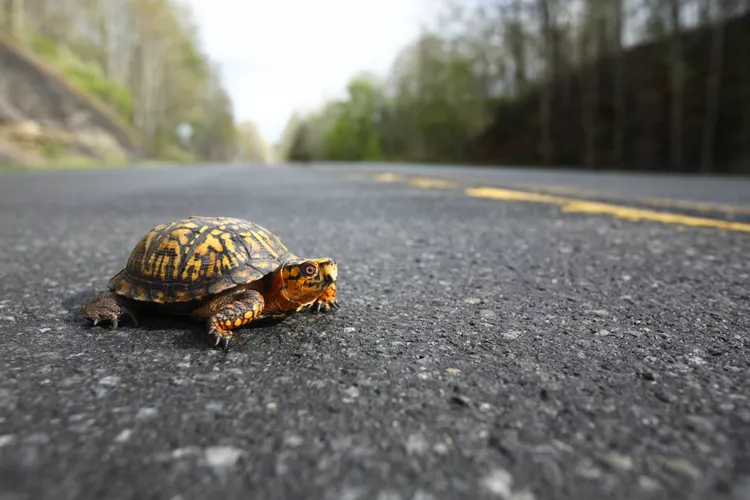
In 2012, Nathan Weaver, a senior a Clemson University, decided to tackle a problem. He noticed that the population of box turtles in the area was in decline, and — despite turtles being very slow and easily avoidable if a driver chose to do so — roadkill was a major factor. His goal was to try to create a safer way for the turtles to cross the road. But to do so, he needed to better understand the cause of the squished turtles. So Weaver designed an experiment to study the problem, placing realistic rubber turtles in the middle of a busy lane near campus. Then he stepped back and watched.
And he discovered that the solution needed was, sadly, simple: people needed to stop being jerks.
Over the course of an hour, as the Associated Press reported, seven drivers deliberately swerved to crush the fake turtle. Several more appeared to try but missed. Another day of observation yielded similar results — he placed his fake turtles on a residential street, and per the AP, the second car to pass by crossed the center line just to pulverize the decoy. Per HufPost, in the first phase of his experiment, “seven out of 267 cars purposely crushed the fake turtles in the space of an hour” — about 2.6%. And those numbers held up over the course of his other trials.
The findings weren’t surprising to Hal Herzog, a psychology professor at Western Carolina University and author of a book about humans’ relationships with animals called Some We Love, Some We Hate, Some We Eat. As Herzog explained to Forbes, “sometimes humans feel a need to prove they are the dominant species on this planet by taking a two-ton metal vehicle and squishing a defenseless creature under the tires.” He added: “They aren’t thinking, really. It is not something people think about. It just seems fun at the time.”
To test whether this was generational, Herzog polled a class of about 110 students before a final exam. He asked how many had intentionally run over a turtle, or been in a car with someone who did. Thirty-four students raised their hands — about a third of the class, roughly two-thirds of them male. (So maybe that 2.6% number is somehow low — although it’s hard to say, as bystanders are mixed in with turtle targetters.)
Unfortunately, the toll on turtle populations is real. According to Smithsonian, research shows that American aquatic turtles have an unusually high ratio of males to females, because so many females are killed while crossing roads to reach nesting areas. There ongoing efforts to help save the turtles from being smushed — turtle underpasses are a thing, after all — but unless we can get teens and others to drive around, instead of at, the animals, it may be a losing effort.
Bonus fact: Ancient Egyptians probably would have been OK with the 2.6% of the population alluded to above, because apparently, they really hated turtles. One of their gods, Apesh — the god of the night — was depicted as something with the body of a human but the head of a turtle, chosen because of how much turtles were reviled. Per the Wikipedia entry for Apesh (which has a drawing of the turtle-headed god), one text even goes as far to say “May Ra [the sun god] live and the turtle die.”
From the Archives: The Tunnels that Save Turtles from Trains: As noted above, turtle tunnels exist.