
The Opposite of a Ringing Endorsement?
If you’re looking for lunch today, fast food is an option — maybe not a great one, health-wise, but there’s a reason junk food is so enticing. Sometimes, a burger and fries — no, let’s go with onion rings — sounds like a perfect fit.
That’s what The Varsity, a burger joint in the Atlanta area, banks on. Since 1928, it’s been serving that type of fare virtually every day, and people keep coming back nearly a century later. It’s not for everyone — I’ll pass on the chili-covered hot dog garnished with cheese and cole slaw, sorry — and it’s not every day. But the eatery has become a local institution. At least three presidents have visited the location — their website contains pictures of Jimmy Carter, George H.W. Bush, and Bill Clinton stopping by.
But not everyone is a fan of the place. Because in 1996, they made some enemies — over those above-mentioned onion rings.
Kind of.
Let’s start with a picture.
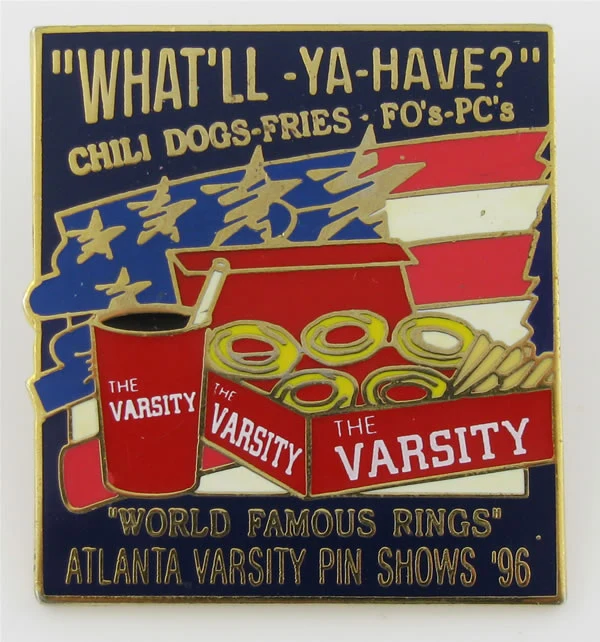
That’s a pin — something pin collectors collect and stick on pin boards or whatever else pin collectors stick their pins on. It seems pretty noncontroversial, and at first blush, it should — The Varsity has created other pins extolling the wonder of their onion rings before without creating a brouhaha — and those pins now go for about $10-15. But this one? You can’t get one — at least, not for cheap.
If you’re not familiar with pin collecting, it’s a fun hobby that also can tie back into your life experiences — if you visit a place, you pick up a pin or two, and you’ve built a collection that ties back to your own life’s story. And it also has specific cultural significance to a few fan communities — it’s big at Disney theme parks and, importantly for our purposes, among Olympic attendees. That last group is important because, when it comes to enforcing use of the Olympics’ trademarks in the United States, U.S. law grants the United States Olympic and Paralympic Committee, and by extension the International Olympic Committee, broad rights to enforce Olympic trademarks.
And the Olympic rings were, almost certainly, the impetus behind the design of the pin pictured above. Atlanta hosted the 1996 Summer Games, and the reference to the “World Famous Rings” was very likely a reference to the five interlocking rings that comprise the Olympic symbol. And the positioning of the onion rings in the snack box itself? That caused even more concern. As The Varsity’s website further explains, “the International Olympic Committee thought the rings looked too much like their trademarked Olympic rings. Claiming an unauthorized use of the Olympic symbol, they stopped the sale of the pin and confiscated those on hand at The Varsity.”
The restaurant complied and the pin is now a very rare collector’s item, often available on eBay for hundreds of dollars.
More About The Olympics
Today’s Bonus fact: If you actually read the U.S. law linked to above, you’ll see that the USOC has broad powers to stop you from using the word “Olympic.” If you do so in a way that could be inferred to assign an association with the Games, they can stop you pretty easily, and there are dozens of examples throughout the years of exactly that happening. But the law has an exception for “such business, goods, or services are operated, sold, and marketed in the State of Washington west of the Cascade Mountain range and operations, sales, and marketing outside of this area are not substantial.” Why? Because that’s roughly where the Olympic Peninsula is, and the law specifically recognizes that people and businesses there might use “Olympic” to refer to the local geography rather than the Games. And it would be ridiculously unfair to the people there if the USOC could shut down any use of ‘Olympic’ there.
From the Archives: How Brazil Got to the 1932 Olympics (Mostly): It took a bit.