
How Cap’n Crunch Made Free Phone Calls
There’s a very good chance that you’re reading these words on your phone. If not, your phone is probably in your pocket. And if you decide to make a call on it right now, you’re probably not paying a per-call or per-minute rate for that service — the cost is baked into your monthly fee. But a long time ago — that is, only a few decades back — that wasn’t true. For most of the 20th century, if you made a call, the phone company charged you a few cents a minute. And if you made a long-distance call, that per-minute charge could be a lot, lot more.
Unless you knew how to whistle. Or if your favorite breakfast cereal was Cap’n Crunch.
To understand why, you need to first understand how phone systems used to work. When commercial phone service first came on the scene, you couldn’t just call up a friend and start talking. Your phone was connected to a switchboard via a wire; when you made your call, a switchboard operator would plug your wire into the appropriate hole at the switchboard, connecting your wire to the one that ran to your friend’s house. That was very inefficient and expensive, so phone companies looked for technological solutions.
In the 1950s, AT&T implemented a system that used sound to replace a large part of that process. The telephone network used specific tones to communicate with its now-automated switching equipment, signaling things like whether a long-distance line was available. One of those tones was a 2600 Hertz signal, which could indicate that the service was ready for a new long-distance call. (Listen to that tone here, but warning, it’s a high-pitched noise that may bother you.)
But hanging up the phone wasn’t the only way to create a 2600 Hz tone. In the mid-to-late 1950s, a blind seven-year-old boy named Joe Engressia accidentally discovered that he could produce the same sound on command and achieve the same effect. He had perfect pitch and, while on a call with a service that offered pre-recorded information, happened to whistle at fourth E above middle C (which is just over 2600 Hz). The recording stopped but the phone line didn’t disconnect. Word of this discovery spread among the phone hacking community known as “phreaking” — a portmanteau of sorts for people described as “phone freaks.” Phreakers soon realized that Engressia’s whistle created a magic opportunity: you could use it to make free long-distance phone calls.
The idea was simple… well, simple-ish. Local phone calls were cheap, so you’d make a local call and then produce a 2600 Hz tone. That signal ended your current call and, for reasons too complicated for our purposes, tricked the phone system into opening a long-distance line for free. Once the trunk was seized, the phreaker could use the telephone network’s signaling system to dial the desired number.
For someone with perfect pitch like Engressia, producing a 2600 Hz tone was simple — and he could use that whistle to help place long-distance calls without paying the usual charges. But most people can’t do that. Enter breakfast cereal.
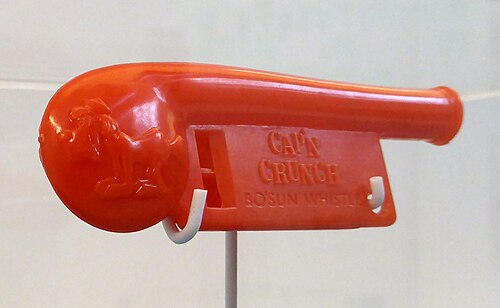
For generations, sugar cereals have included a toy surprise at times, incentivizing kids to ask their parents to buy it for them for breakfast. In 1963, Cap’n Crunch did exactly that, including a “bosun whistle,” seen at the top, in their cereal boxes. For years, no one thought much of these toys — they were cheap plastic afterthoughts, after all. But in 1969, a former U.S. Air Force engineer named John Draper became interested in hacking into computer systems and phreaking specifically. As IFL Science explains, Draper “noticed that the whistle toys inside Cap’n Crunch cereal packets played perfectly at around the 2,600 hertz needed to hack the phone lines. He used the tones created to make free phone calls over AT&T, and the whistles became iconic in the phreaking community.“
The Cap’n Crunch whistles became an iconic part of phreaker culture and Draper himself became widely known as “Captain Crunch” within those circles. In 1971, the popularity of phone phreaking went mainstream when Esquire magazine ran a story on the hobby, with Draper appearing throughout the piece. Unfortunately for Draper, that also drew the gaze of the law — his habit of whistling his way into free long distance calls happened to run afoul of federal wire fraud laws. He pleaded no contest and agreed to a $1,000 fine, a one-year suspended sentence, and five years of probation — and also agreed not to discuss with anyone how to crack into phone systems from that point on.
Draper ended up violating that last condition in 1975, telling an undercover officer all about the technology he was using, and he ended up going back to prison. The telecommunications industry worked with law enforcement to crack down further on those exploiting the whistles. And in the 1980s, AT&T and others transitioned its technology to create a new signaling system that couldn’t be cracked by a Cap’n Crunch giveaway. By the 1990s, classic 2600 Hz phreaking was largely a thing of the past.
Bonus fact: Western Union, once a giant in the telegraph space, had a chance to dominate the phone industry too. As Elon University notes, Alexander Graham Bell, the inventor of the telephone, “offered to sell his telephone patent to Western Union for $100,000 in 1876, when he was struggling with the business.” That was a lot of money — inflation calculators only go back to 1913, and $100k then was more than $3.5 million today — but Western Union almost certainly could have afforded it. They passed, though; per the Elon University report, they found the invention to lack any serious value, being more of a toy than anything useful.
From the Archives: The History of Being on Hold: Someone had to come up with this idea, right?