
The Billboard That Became an LA New Year’s Tradition
Every New Year’s Eve, about a million people cram into a few-block radius in Manhattan. They gather to ring in the new year in perhaps the most famous place to do so — Times Square. As the clock ticks down toward midnight, a crystal ball drops slowly, and when it hits the bottom of its descent, the calendar has flipped into January. If you’re into sharing a moment like this with extremely large crowds, it’s a blast.
But not all cities have such an event, and not everyone is going to hop on a plane to come to New York City just to celebrate a new beginning. As a result, communities around the globe have created their own customs — finding places to gather to celebrate with friends and strangers alike. And in one case, the gathering place is kind of morbid: a billboard about death.
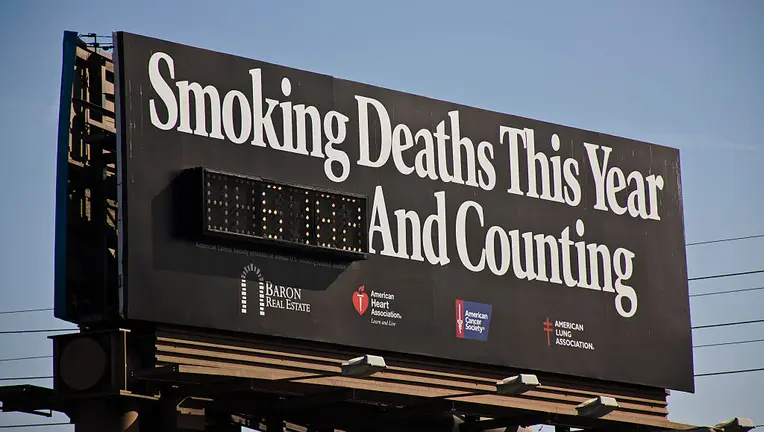
The billboard, seen above (via Fox 11 Los Angeles) is near the intersection of Santa Monica Boulevard and Veteran Avenue in West Los Angeles. And it has nothing to do with New Year’s Eve — at least, not directly. It’s there to encourage people not to smoke cigarettes. It was created by a man named William E. Bloomfield Sr., a former smoker who made his fortune putting coin-operated washers and dryers in apartment buildings and college dorms. He didn’t need to put up an anti-smoking billboard; he wanted to. As he told the Los Angeles Times at the time, “I want to do what I can to get even a few people to quit, or at least think about it.”
It’s a simple idea, really — it estimates the number of tobacco-related deaths each year, to give smokers (or would-be smokers) a grim reminder of the reality that smoking can lead to. The sign’s white-on-black letters read “Smoking Deaths This Year,” and underneath is a digital counter that ticks upward, adding one to the tally roughly every minute or so. The number is based on statistical averages from groups like the American Heart Association, American Lung Association, and American Cancer Society — no one is calling hospitals. But over the course of a year, the count climbs into the hundreds of thousands, a quiet, relentless reminder of tobacco’s toll on American lives.
But on December 31, the sign serves a secondary purpose. As the count on the sign shows deaths “this year,” it resets as the clock strikes midnight. So, just before midnight, a crowd gathers beneath the sign. At the stroke of twelve, the crowd cheers. Not because no one has died (yet) this year from smoking, but simply because a new year has begun.
The tradition has grown considerably since the Los Angeles Times first wrote about it in 2012. Back then, it was a neighborhood gathering of maybe 30 people — some curious, some a little drunk, some who had made it a family tradition. But it’s gone viral since. In the early 2020s, Reddit users began loosely coordinating meetups, and the crowd swelled. Today, some call it the LA equivalent of New York’s celebration, with more and more people gathering at the billboard each year.
And in doing so, they may have helped save lives. The American Cancer Society, one of the billboard’s sponsors, has embraced the tradition. “Seeing the social media response of Angelenos counting down the New Year alongside this billboard is a powerful example of how impactful public awareness can be,” Jen Maduko, the organization’s senior executive director in Los Angeles, told LAist. She added that she hopes the attention encourages smokers to quit — or at least to get screened.
Bonus fact: Anti-smoking campaigns are a lot older than modern warning labels (and billboards). In 1604, King James I published A Counterblaste to Tobacco, one of the earliest known anti-smoking essays. In it, he blasted the habit as disgusting (“hatefull to the Nose”) and dangerous (“harmefull to the braine, dangerous to the Lungs”). He also complained about what we call secondhand smoke — then followed it up by slapping a steep tobacco import duty on the product, equal to about $130/pound ($260/kg).
From the Archives: The Faults in Their Stars: New York City has an anti-smoking sign (of sorts) of its own, and it’s in a very unusual place.