The Desert’s Night Lights
The Al-Nafud Desert, sometimes called the Great Nafud, sprawls across roughly 64,000 square kilometers of northern Saudi Arabia. (Here’s a map.) It’s a punishing landscape, known for its high temperatures, scarce water sources, and disorienting sameness — not somewhere you typically want to go for a casual walk. But that doesn’t preclude adventurers from exploring the sandy terrain. The once-or-twice a year rainfall the Nafud receives is enough to sustain a few oases scattered around the huge sand dunes, and that’s enough to sustain outdoorspeople who want to see this kind of climate zone first hand.
But these excusions are dangerous, to say the least. According to a report from Enjad, a volunteer search and rescue team, over 13,000 vehicles were reported stranded in Saudi deserts in some years. Of the 142 people cited in the report who went missing on foot, 28 lost their lives and 14 remain unaccounted for. Desert rescuers have noted that some of those who perish are found heartbreakingly close to water sources they never knew were there. As Mohammad Fohaid Al-Sohaiman Al-Rammali, an environmental activist and explorer, told Arab News: “Many people lost their lives in the desert near water resources because they did not know that water resources were close to them.”
Al-Sohaiman knows the desert intimately — he’s been involved in multiple rescue attempts in the region north of Hail. And he came to a realization: even skilled survivalists can miss a water source when they’re panicked and exhausted. The desert plays tricks on you. Mirages bend light on the horizon; desperation narrows your focus. What you need, in that moment, isn’t a map or even GPS. What you need is something you can’t possibly miss. A beacon, if you will.
So Al-Sohaiman created exactly that — a big glowing light in the middle of nowhere. A laser beam shot into the sky, like the one seen below.
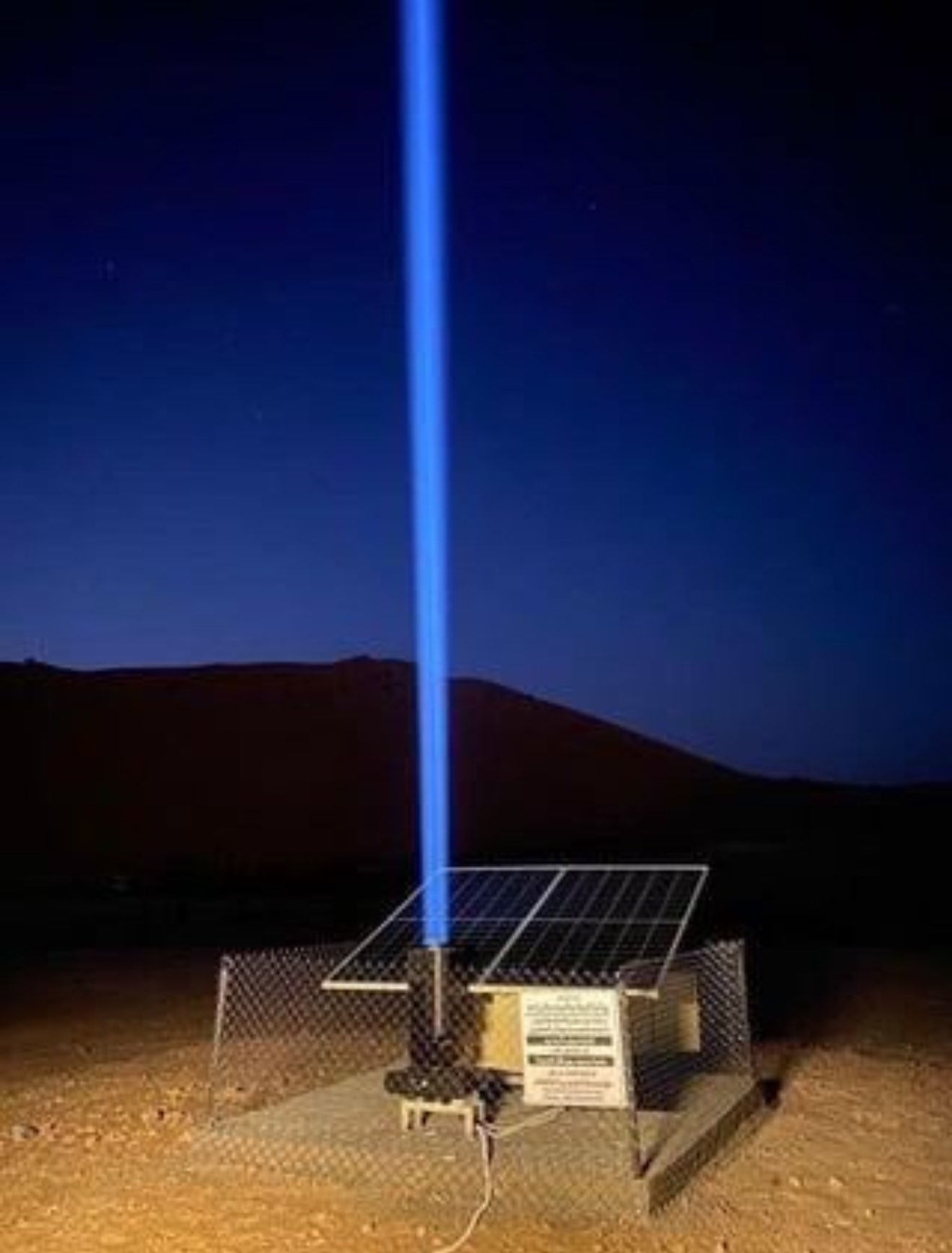
Working with a specialized company under the Ministry of Environment, Agriculture and Water, Al-Sohaiman helped develop these solar-powered laser beacons positioned near water wells throughout the desert. The beacons activate at night, projecting vibrant columns of light visible from miles away. The first eleven went live in 2021, and the plan, backed by a regional businessman, is to eventually install 100 beacons across the area. As Upworthy noted, the beacons look almost exactly like save points in a video game — except these ones might actually save your life.
Not everyone is thrilled. Critics have pointed out that the light pollution could harm the desert’s nocturnal wildlife and insect populations. But for the families of those 28 people who died lost in the sand, a laser piercing the night sky probably seems like a reasonable tradeoff. Sometimes, the simplest ideas are the best ones: if someone is lost, give them a light to follow.
Bonus fact: Saudi Arabia is one of the driest countries in the world, with vast stretches of desert and very little rainfall. Yet, it is a dairy powerhouse, producing more milk per capita than many other nations. The trick — companies there have built what, effectively, are cow resorts. Food and water is brought in, ensuring the dairy cows have enough to eat or drink. The farms have air-conditioned barns that keep the cows comfortable. As CNN explains, The farms have air conditioned barns, keeping the cows maintaining “a perfect temperature of between 21 and 23 degrees Celsius (70 and 73 degrees Fahrenheit) is automated. Overhead misters in the open-sided sheds that house the herds send out clouds of moisture that wet the flanks of the herd to keep them cool. Fans also keep them dry and prevent puddles from forming.” According to CNN, cows on these Saudi dairy farms produce nearly twice as much milk per animal as the average cow on many European farms.
From the Archives: The Swimming Pool Hiding in the Middle of the Desert: No lasers here, and maybe, no water — due to its lack of upkeep.