
The Ordinary People Who Saved the Bluebird
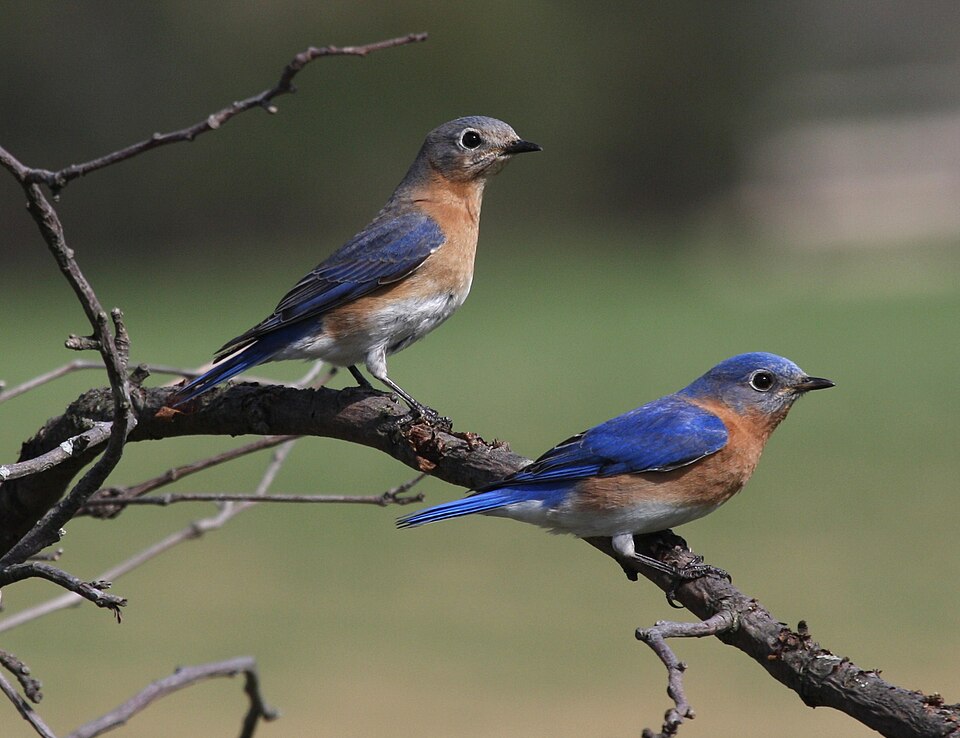
If you live in the eastern United States, stretching past the Mississippi, there’s a good chance you’ll come across a bluebird when the weather is right. Specifically, you’ll be looking at an Eastern bluebird, like the pair pictured above. They’re a very common species of bird — the state bird of both New York and Missouri — and by no means a threatened species.
But for a while, that wasn’t the case. There was a time when seeing a bluebird felt less like spotting a bird and more like witnessing a small miracle. But then, the Eastern bluebird population made a comeback. The hero?
A lot of volunteers — and an ordinary box.
The Eastern bluebird had a simple problem — habitat loss. As the Cornell Lab’s All About Birds guide explains, the birds nest in cavities, and “typically select old woodpecker holes in dead pine or oak trees, up to 50 feet off the ground.” But as farms modernized and suburbs spread in the mid-20th century, those natural cavities disappeared. Worse, aggressive nonnative competitors like the European starling and house sparrow took over what was left. According to the Washington Post, by the 1970s, the Eastern bluebird “had become almost extinct in many areas due to the loss of nesting sites, parasite infestation, and the harmful effects of bad weather.”
One can’t turn back time and magically make 50-foot trees reappear on the landscape. It looked bad for the birds. But it turns out, you don’t need a big oak tree to create a suitable niche for a bluebird. You just need something with an opening and appropriately-sized cavity — the rest of the tree was optional. So people started building new holes.
Ordinary bird enthusiasts began putting up small wooden nesting boxes with precisely sized entrance holes — large enough for a bluebird, too small for other bird species (like starlings and sparrows) that took over the nooks in the trees. And they checked in on the boxes, ensuring that the bluebirds weren’t crowded out by unwelcome guests. Audubon Societies and local birding groups across the country rallied to get volunteers, building birdhouses and babysitting the boxes. In 1977, an author and biochemist named Lawrence Zeleny — alarmed by the bluebird population loss — wrote an article for National Geographic titled “Song of Hope for the Bluebird,” outlining how virtually anyone could build an appropriate nesting box. That same year, Zeleny founded the North American Bluebird Society, bringing together fans — and saviors — of the bluebird population under one banner.
(And, yes, you can get involved — if you want to build your own, here’s a pdf with some plans.)
Today, the Eastern bluebird is again ubiquitous. It came back because thousands of people hammered together small wooden boxes and nailed them to posts. They checked on them like landlords making polite house calls. And now, if you drive past an open field and notice a flash of blue perched on a wire, you’re not seeing a miracle. You’re seeing what happens when regular people decide to make a difference.
Bonus fact: The European starling is one of the birds that push bluebirds out of nesting sites. But the starling shouldn’t be in the Americas in the first place. You can blame William Shakespeare for that — kind of. In 1890, a drug manufacturer named Eugene Schieffelin decided that New York’s Central Park needed to play host to every bird mentioned in Shakespeare’s collected works, and he began to import birds from around the world to Manhattan. As Smithsonian Magazine reported, “there was every reason to believe that the birds would die — it was bitterly cold and sleeting, and attempts with other species had led to dead birds.” That prediction proved false, as many birds survived and bred. Today, there are millions of European starlings in North America, menacing other species.
From the Archives: How Bird Poop Shaped Our Maps: It was a highly-desired resource!