
The President that Fleeced the Country
The White House is an iconic part of Americana, and it’s important that it look good. As a result, administrations typically take time and effort to make sure the lawn is well-manicured. For most of American history that meant a staff with mowers and shears and the like. But in the spring of 1918, the United States was a year into World War I, and any man holding a job that could be done by someone — or something — else was a man who could be sent to France instead. That posed a problem for President Woodrow Wilson: the White House needed its grass cut and its groundskeepers freed up, and those two needs were pulling in opposite directions.
Sheepishly, he came up with a solution.
No, I mean, he came up with a solution — sheep, as seen below.
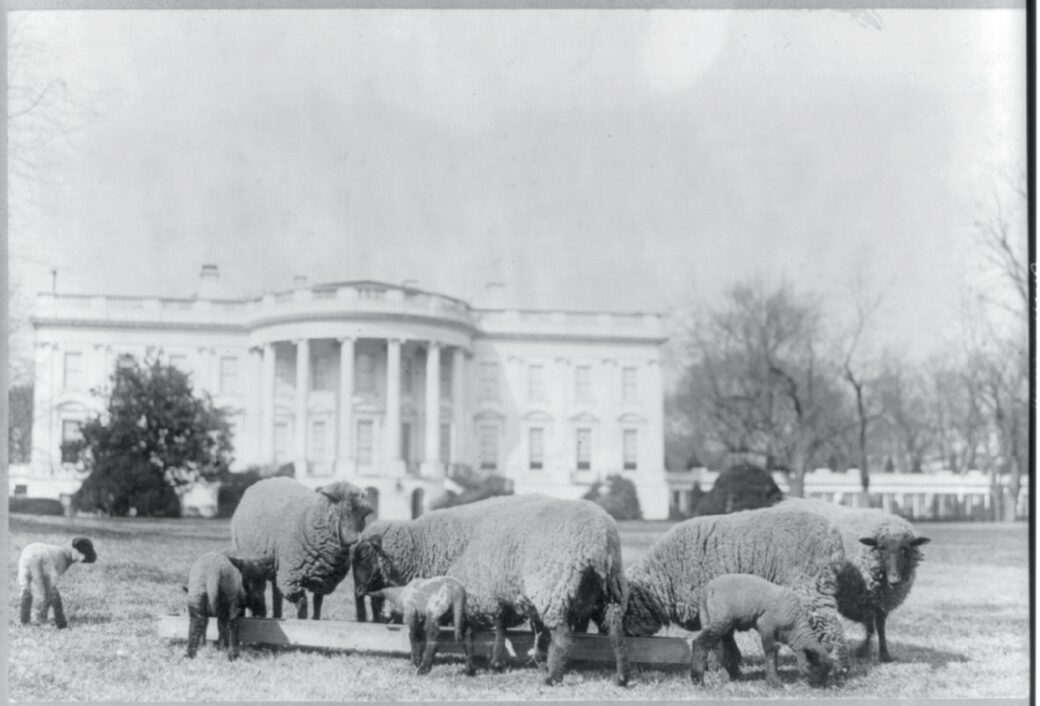
The idea came from Dr. Cary T. Grayson, Wilson’s personal physician, who happened to have useful friends in horse racing. As the Woodrow Wilson Presidential Library and Museum recounts, “Grayson contacted his horse racing acquaintance William Woodward, who owned Belair Farm in Bowie, Maryland. Woodward sent along a small flock, 18 sheep in all, by wagon to the nation’s capital.” The idea was simple: the sheep needed to eat anyway, and grazing on the lawn of the President’s house would mean the grass would always be well tended to.
The idea worked at first, and had a nice side benefit. Sheep grow wool, and wool grown on the President’s lawn was kind of cool, and therefore, rather valuable. (Who wouldn’t want a coat made from White House wool?) A few weeks into the effort, those tending to the flock sheared roughly 90 pounds of wool, about enough for each state (there were only 48 at the time) to receive about two pounds. The governors of each state then auctioned off their allotment, with the proceeds going to the Red Cross War Fund, per a Presidential memo from the time. The effort was a success — Dr. Grayson reported that “the cheapest was $100 per pound,” or the equivalent of about $2,200 today, which is roughly 1,000x more than modern wool wholesalers fetch for the product nowadays. In a time where building cities and roads were important — requiring brick, wood, grain, and iron ore — these auctions proved that Americans still placed a high premium on sheep.
But there were a lot of problems with the sheep-as-mowers scheme. According to WETA’s local history blog Boundary Stones, the sheep turned out to be imperfect employees. They caught pneumonia. They caught something the era called “the dips,” a stress-related ailment which the Wilson Library attributes to the capital’s growing automobile traffic scaring them senseless. And they tore up so much of the back lawn that the whole flock had to be relocated to the front. And that was just the typical sheep. One was far worse than the rest.
That honor wen to Old Ike, the one ram in the flock. (Flocks typically have only one ram per 30 to 50 sheep, as having multiple rams can cause unwanted pregnancies and ram-on-ram turf wars.) By every surviving account, Old Ike was a problem. A 1920 newspaper account quoted by the Presidential Pet Museum described him as “forceful and strategic,” which was a kind way to describe what was really happening — Old Ike had a habit of charging at White House staff and police officers from whichever direction they were least expecting. And that wasn’t his only bad habit. Ike had acquired a taste for tobacco — specifically for the cigar butts that visiting officials and reporters flicked onto the White House grounds, which he would seek out and chew. History.com notes that the cantankerous, cigar-eating ram became a minor celebrity as a result, and not necessarily for the better.
Wilson eventually gave up and banished Ike to Maryland. The rest of the flock followed before long — by August 1920, after three summers of grazing and fundraising, the sheep were sold off. With the war over, humans returned to keep the grounds pristine.