
Why Is a Basketball Team Named After Pants?

Last night, the New York Knicks stunned the San Antonio Spurs in Game 4 of the NBA Finals. With about ten minutes to go in the third quarter, the Spurs held what looked like a commanding 29-point lead. Even as that lead began to wane, the outcome looked hardly in doubt; at one point, as seen in the graph above (via ESPN), the Knicks barely had a half-percent chance of winning.
How did this happen? That’s basketball. But a perhaps deeper question is:
Why is New York’s basketball team named after pants?
Spoiler alert: They aren’t. They’re named after a lie.
Most professional sports teams have nicknames, and usually, those nicknames are a reference to the team’s history or that of their city. The Boston Red Sox are named thusly because in 1908, the team’s owner issued them bright red stockings to wear as part of their uniforms. The Dallas Cowboys get their nickname from the frontiersmen in the region’s history, the Baltimore Orioles are named for the birds commonly found in Maryland, and the Toronto Maple Leafs references the emblem of Canada. Sometimes, it’s even more straightforward than that — the Los Angeles Angels, for example, are the Angels because “Angelos” is Spanish for “Angels.” Other times, the name gets very muddled — the Utah Jazz are the Jazz because they originally played their home games in New Orleans, home to jazz music, and kept the nickname when they moved to a place hardly known for its music.
But when it comes to the New York Knicks, there’s more confusion than typical. “Knicks” is short for “Knickerbocker,” which was a style of baggy, rolled up pants worn in New York and elsewhere, as seen below (via Wikipedia). And as you’ll immediately realize, it’s not a style conducive to dishing or dunking.

It turns out that the team isn’t actually named for the pants themselves. Rather, they have a shared origin.
Early European settlers of the area now known as New York City were predominantly Dutch; they even called the region “New Netherland.” The Dutch influence on the region persists today — the official flag of New York (and by extension, the Knicks and the New York Mets) feature orange and blue, a reference to the flag of New Netherland in the early to mid 1600s. That influence hardly waned as the 1700s yielded to the next century, and it became central to the writing of famed American author Washington Irving.
In 1809, Irving published a novel titled “A History of New York: From the Beginning of the World to the End of the Dutch Dynasty,” a satire of the local politics of his time. But he didn’t sign it under his own name; he adopted a pseudonym and a fake identity — a historian named Diedrich Knickerbocker. To help promote the book, in the weeks before it came out, Irving contacted local New York City newspapers claiming that, in the words of Wikipedia, “well-known Dutch historian Diedrich Knickerbocker (pictured below) had disappeared from his hotel” and that if Knickerbocker wasn’t found, Irving would publish Knickerbocker’s last manuscript — the history book — in an effort to preserve his legacy. Many people were tricked by Irving’s stunt, and the book became an instant success.
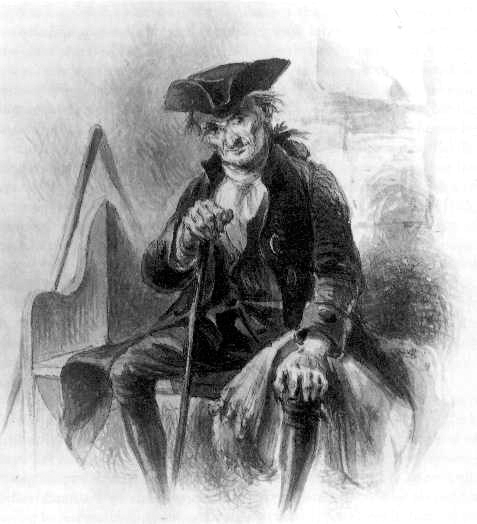
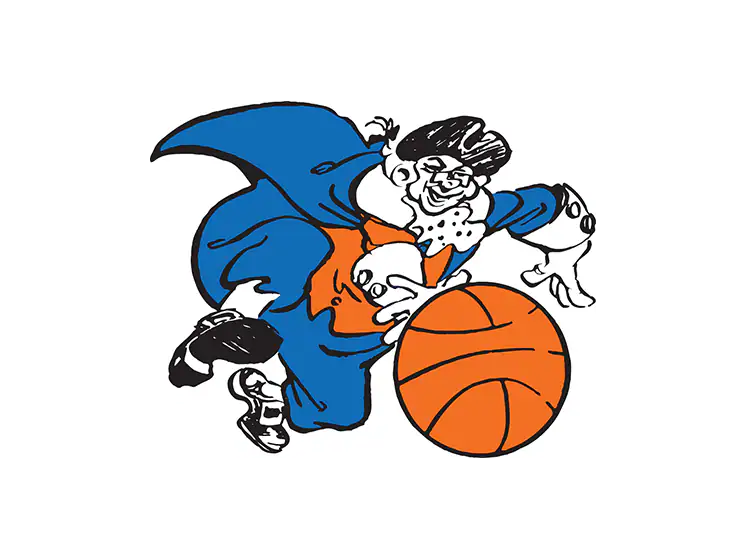
Diedrich Knickerbocker became a New York City icon — and because he was a Dutchman through and through, his attire included, many aspects of his Dutch identity quickly became associated with New York itself. His style of trousers, for example, became known as “knickerbockers” or “knickers.” Broadway shows, hotels, and more adopted the “knickerbocker” label. And eventually, “Father Knickerbocker,” seen below in an early Knicks logo, emerged as a personification of New York City itself, much as Uncle Sam would later symbolize the United States.
In 1845, a century before the New York Knicks were created, the “Knickerbocker” name had already entered the city’s basketball parlance. As the Knicks’ official website explains, “Alexander Cartwright’s Manhattan-based baseball team – the first organized team in baseball history – was named the ‘New York Knickerbockers’ or the ‘Knickerbocker Nine.’” That early league was long gone by the time the Knicks were born, but the history stuck. According to longtime Madison Square Garden executive Fred Podesta (via the Sporting News), team founder Ned Irish and several colleagues settled on the nickname by literally putting possible team names into a hat. The “Knickerbocker” name was so widely associated with New York at the time that most of the slips read “Knickerbockers” — and a team nickname was born. The name was quickly shortened to “Knicks,” and it has remained that way ever since.
Today, you rarely if ever hear about the ties between the Knickerbocker name and the city of New York. The Knicks themselves retired the Father Knickerbocker logo after the 1964 season and, other than an increasingly rare reference to knickers (the pants), you rarely hear the name used outside of basketball circles. But the name persists (and is one win away from an NBA title!) — Washington Irving invented a man who never existed, and New York has been honoring him ever since.
Bonus fact: The San Antonio Spurs are named for the small metal tools that cowboys and others wear on the heels of riding boots — they’re designed to allow riders to give or reinforce a command given to a horse without the riders having to kick hard. Despite their fearsome reputation, spurs aren’t designed to injure horses. Instead, as this study explains, they help riders give clearer, precise cues, making it possible to communicate with a light touch. When used properly, most equestrian organizations see them as a riding aid rather than a means of punishment — more like a polite nudge than a flagrant foul.
From the Archives: Enter the Knickerbocker: Another NYC “Knickerbocker” reference — but this one goes nowhere (and due to recent construction, may be gone… I’ll have to check next time I’m there!).