
Monoculture Versus the Internet
Hi!
Before I get started today, I want to give another thank you to Inkwell Games for sponsoring this week’s newsletters. If you haven’t tried their games yet, please do — they’re the perfect pairing with Now I Know to get you thinking at the start of your day.
As you can imagine, I’m a big fan of the internet. Projects like Now I Know — and, I’m guessing, Inkwell too — are only possible because of the internet. This newsletter has a bit north of 50,000 subscribers — the population of a small American city or roughly enough to sell out a baseball stadium. But you all are spread throughout the planet, not living in my neighborhood. If I were only writing for people in my immediate vicinity, Now I Know wouldn’t exist. The internet has unlocked opportunities that a generation or two ago could barely imagine.
But this week has reminded me that this has come at a price — one, I think, worth paying, and perhaps one that wasn’t actually a good thing anyway. The “monoculture.”
The idea behind the monoculture is simple. Once TV became nearly universal in American homes (and apologies to those outside the U.S.), TV programming became the anchor of popular culture. The most popular shows became must-watch TV not only because the programs were, ostensibly, good, but because everyone else was watching the same thing. You just couldn’t be part of the watercooler conversations without having watched whatever constituted must-see-TV.
But that’s pretty much gone now. Cable television was the first crack — many more channels, many more choices, a lot of people watching different things. Then came the internet and streaming TV. Smash hits like Stranger Things or Emmy Award-winners like Schitt’s Creek have certainly become cultural touchstones, but you’re not terribly surprised when one — or many — of your friends have never bothered watching it. That certainly wasn’t true when the top shows on TV were MASH, Cheers, Seinfeld, or even Friends.
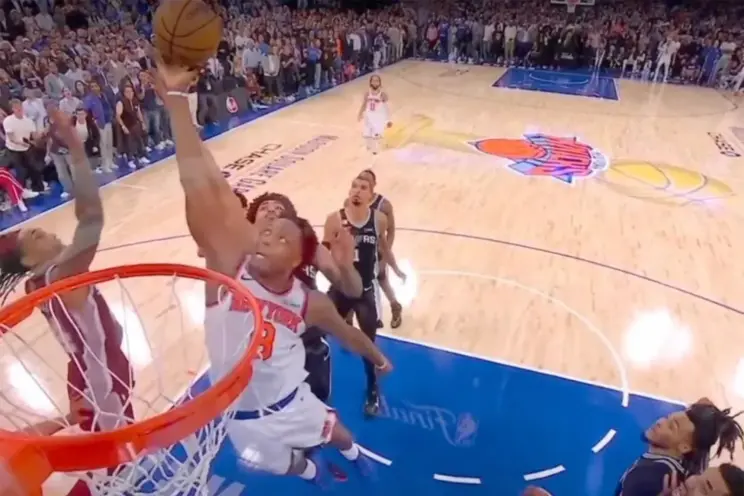
Yesterday, though, was different — at least here in the NYC area. Everybody — and I mean everybody — was talking about the basketball game, and specifically, the put back pictured above. People who had never watched a Knicks game in, perhaps, their lives — they were talking about it. There was a certain magic about it. Wherever you went, you could just step right into the conversation. We all, briefly, had a common bond that went beyond the details of our personal lives, and I have to admit, it was kind of magical.
Again, I think the diversification of media is well worth giving that up. But it’s nice to have experienced it again.
Long Reads and Other Things
Here are a few things you may want to check out over the weekend:
1) “This Wine Was the Toast of the World. Now Even the Locals Don’t Drink It.” (New York Times/gift link, 9 minutes, June 2026). The Bordeaux region of France — of the world’s most famous wine regions — has become so associated with expensive, old-fashioned luxury wines that even many people who live there now prefer to drink wines from somewhere else.
2) “Ping-pong sponges, ‘black smokers’ and floating somethings: the secrets of the deep sea” (The Guardian, 17 minutes, June 2026). This is about the mysteries of the ocean — the final frontier that’s actually accessible without warp speed.
3) “The Grate Cheese Robbery” (Longreads, 17 minutes, May 2026). The subhead: “How organized crime fell in love with cheese.”
A bonus: “3 A.M. Thoughts on the Greatest Knicks Win Ever” (The New Yorker, 8 minutes, June 2026). Sorry if this hits a paywall — it’s actually pretty skippable anyway, hence the “bonus” — but I’m still loving the moment.
Have a great weekend — and let’s go Knicks!
Dan