
Norway’s Raw Deal
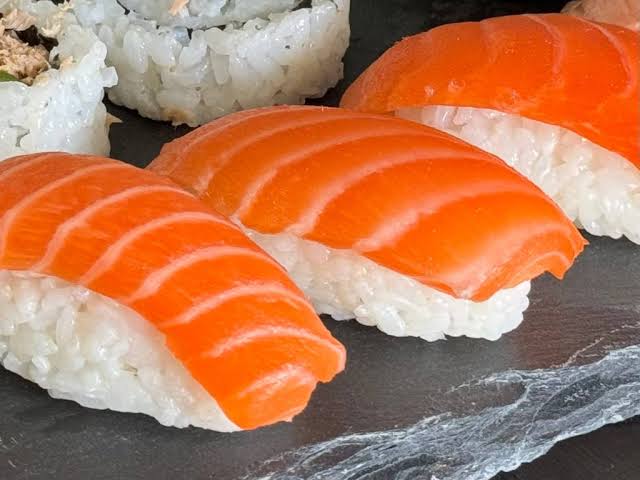
Walk into just about any sushi spot in America, scan the menu, and salmon is right there — a bright orange slab draped over rice (as seen above), rolled up with avocado, sliced thin for sashimi, or maybe even in some weird pizza-like form. Do the same thing in Tokyo and you’ll find exactly that, too, perhaps minus the pizza version. Salmon is one of the most popular sushi fish in Japan, so deeply a part of the experience that it feels about as old and as Japanese as the rice underneath it.
It isn’t. It’s the result of a foreign marketing campaign.
For most of Japanese history, nobody there ate salmon raw, and for a good reason: the wild Pacific salmon in Japanese waters were riddled with parasites. Cooked or salted, salmon was fine — and cheap enough that, as Tokyo Weekender has noted, it was long considered something of a poor man’s fish. The idea of laying a slice of it, uncooked, across a pillow of rice was not tradition flouted so much as tradition that had simply never existed. It was considered unsafe to eat — not a go-to lunch option.
Norway, meanwhile, had a different problem: too much salmon and nowhere to put it. The country had thrown itself into farming Atlantic salmon in the 1970s, and by the mid-’80s it was producing far more than the world was buying. Its farmed fish also happened to be free of the parasites that made the Pacific catch unsafe raw — which meant Norway was sitting on a mountain of premium, sushi-grade salmon and a nation of enthusiastic fish-eaters who wanted nothing to do with it. So in 1985, a delegation led by former fisheries minister Thor Listau launched an effort called “Project Japan,” and hired a market strategist named Bjørn Eirik Olsen to crack the market open.
The Japanese, to put it plainly, were not interested. Sushi chefs turned up their noses at the color, the smell, even the shape of the fish’s head, and no amount of advertising about pure, cold Norwegian waters changed their minds. Norway went so far as to rebrand the fish in katakana as sāmon — a deliberate break from sake, the word for the old cooked salmon, so buyers wouldn’t picture the grilled poor man’s fish. But the campaign didn’t work. In fact, it got worse.
In the autumn of 1991, Norway’s salmon farmers’ sales collapsed, leaving roughly 30,000 tons of frozen salmon in storage with no one to buy it. The obvious escape was to dump the glut cheap into Japan’s cooking market and take whatever it fetched. Olsen, though, refused — he understood that a fire sale would brand Norwegian salmon, permanently, as ordinary grilling fish, and slam the sushi door for good.
Instead, around 1992, he made a bet. He offered to sell about 5,000 tons to Nichirei, one of Japan’s largest frozen-food companies, at a low price — with one condition attached: the fish could only be sold as sushi. Nichirei, seeing the unique opportunity to turn a massive profit, agreed. Suddenly salmon was in supermarket cases and rotating past diners on conveyor belts, cheap and everywhere, and people finally tasted it. One Tokyo native described the conversion to NPR about as economically as you can: “at first time I said, eh, but…second time, maybe, third time, OK.” And that’s all it took, because let’s face it, salmon sushi is pretty great.
So as we all know today, it stuck as a staple of Japanese cuisine. And that helped establish a trade relationship between Norway and Japan for decades. Norway shipped Japan only two tons of salmon in 1980; twenty years later it was sending more than 45,000 tons a year, and salmon had climbed to the top of the country’s sushi rankings, where it has more or less stayed. Next time you order the most authentic-looking thing at the sushi counter, then, thank Norwegian desperation and marketing.
Bonus fact: Rice is a defining element of sushi, and good rice can enhance the dish (while bad rice… not so much). But that wasn’t originally the case. As the South China Morning Post notes, “the rice in the original ‘sushi’ was not intended to be eaten. Mixed with salt, it was used to preserve the fish and then thrown out.”
From the Archives: A Fishy Way to Get a Free Meal: He was after salmon sushi, so he became salmon sushi. Kind of.