
A Gold Medal For Shooting Your Friend?
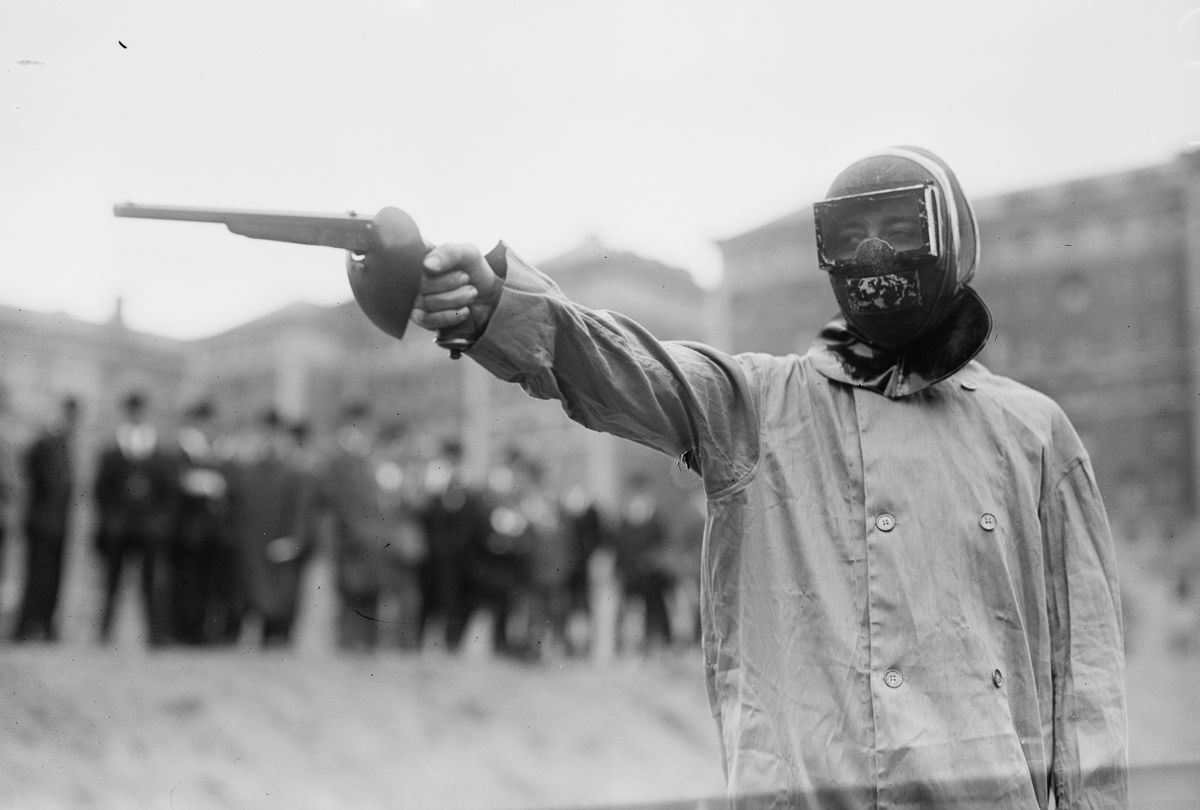
Take a look at the photo above. The person standing there looks like a beekeeper who got dressed in the dark — a heavy canvas robe, a full hood, a mask of wire and plate glass strapped over the whole face. Whatever they’re about to do, it clearly involves something that stings — until you look what’s in their hand. It’s not a smoker or a hive tool. It’s a pistol, with a strange metal cage bolted around the grip.
So, a few reasonable guesses. They’re about to open the angriest hive in the county. They’re a welder who wandered onto the wrong film set. They’re the goalie for a sport that hasn’t been invented yet.
Not quite, although that last one is kind of close. The person pictured above is competing in the Olympics — by shooting at their adversary. With permission, of course.
The event was pistol dueling — yes, shooting other people — and for a brief, strange stretch in the early 1900s, people took it seriously as a sport. The idea came out of France, where — as Mental Floss explains — a doctor named Paul Devillers worked out in 1901 how to have all the drama of a duel without the inconvenient part where someone dies. His solution was the wax bullet: a ball of tallow launched by a primer with no gunpowder behind it, slow enough that it stung like you-know-what but (usually) didn’t break the skin. Paris even opened a “School of Dueling” to teach the thing, where students wore fencing masks and followed the full honor code — right down to the part where two grown men agreed to shoot each other over an insult.
It was, somehow, popular. So popular, in fact, that the Olympics wanted it as a competitive sport. At the 1906 Games in Athens, competitors fired at plaster dummies dressed in frock coats from up to 30 meters away, and a Frenchman named Léon Moreaux took the gold. Two years later, at the 1908 London Games, an American marksman named Walter Winans organized a public demonstration in which the dummies were replaced by actual people (who, reasonably, could also be called “dummies.”) Eleven men from four countries stood on the fencing grounds and fired wax at one another’s chests, and at one point a French major named Ferrus scored a direct hit on Winans’s heart — which, given that everyone walked away without need of a hospital or an undertaker, counted as a good day.
If all of this sounds familiar, it should. Strip away the frock coats and it’s paintball: two people in protective gear firing non-lethal projectiles at each other for sport, occasionally leaving a welt. The only real difference is that nobody has ever seriously proposed handing out Olympic medals for paintball — which, if you’ve ever played paintball, makes sense, because getting shot even by a non-lethal projectile is still rather dangerous.
And that wasn’t a surprise to the people who participated in the wax bullet duels of a century-plus ago. The wax bullets, it turned out, were not entirely bloodless. Winans himself — who did as much as anyone to sell the sport — kept warning people how dangerous it was, cautioning that spectators “might lose their eyes by a stray or ricochet bullet,” according to Ripley’s. He also freely owned up to the damage he’d done, recounting an early bout, per Mashable, in which “I shot out the soft piece of flesh connecting the thumb and forefinger of the right hand of M. Gustave Voulquin, the well-known sports writer; and he tells me it still pains him when he has a lot of writing to do.” That’s a ringing endorsement of the sport if there ever was one.
But besides the obvious flaws in the sport, it still spread internationally for a while. America got its turn on March 10, 1909, when two members of the Carnegie Sword and Pistol Club faced off in the gymnasium at Carnegie Hall: Dr. Graeme M. Hammond, president of the Amateur Fencing League of America, and C.B. Miller of Columbia University. They stood 60 feet apart in black robes and masks, .44 caliber French pistols loaded with imported wax, and shot each other in front of a small crowd. Both men were, as the New York Times reported, “theoretically pronounced dead,” and the “supposedly fatal results created general merriment.”
The merriment didn’t last into the next decade, though. Real guns kept getting better and real duels kept getting deadlier, and the whole polite charade faded out within a decade or two. Today, a wounded ego reaches for a lawyer instead of a wax-loaded .44 — which is slower, far more expensive, and produces nothing anyone would ever pay to watch. But at least no one risks death in the process.
Bonus fact: Is Tom Cruise a holy man? No, but he makes for a decent wax replica. Mansfield, Ohio, is the home to BibleWalk — the only wax museum in the state, according to the museum’s official website. Wax sculptures are expensive, though, so BibleWalk does something creative — they purchase used wax sculptures and repurpose them as needed for the religious-themed displays in their halls. For example, as Yahoo reported in 2015 (and there’s a picture of this, so be sure to click), “Tom Cruise appears as Jesus and prepares to receive the baptismal blessing of John the Baptist.” And Cruise isn’t alone — dozens of other famous people who, in generally, don’t appear in biblical stories have their likeness on display at BibleWalk. Per Yahoo, the museum curators realize that patrons may, at times, recognize a celebrity stand-in, but the curators claim no one seems to mind: guests, they assert, “are so in tune to the story that’s going on as they’re walking through the museum that it’s really not too much of a distraction.”
From the Archives: The Second Life of Crayons: Wax can be reused in helpful ways.