
How to Steal a House?
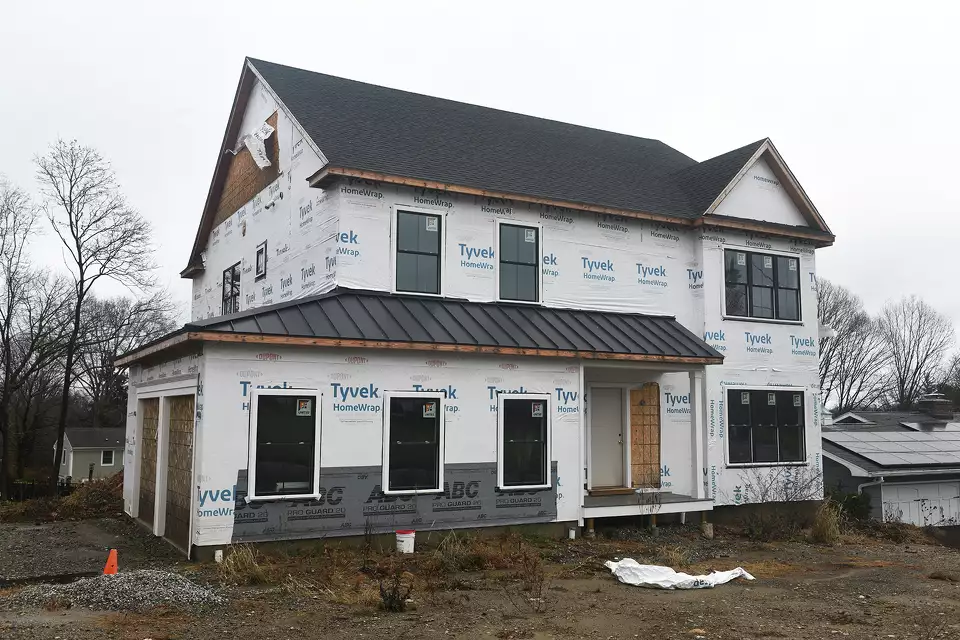
Fairfield, Connecticut, isn’t the sort of place where residents worry about theft. It’s a small, quiet suburb of New York City, probably best known for its strong public schools, high-ish property taxes, and — important for our purposes today — low crime. Homeowners probably have alarm systems, but break-ins in the area are rare, to say the least.
But when something is stolen, it’s big. Like an entire house — and the land under it.
The under-construction home pictured above was built, mostly, in 2023. It shares a U-shaped street with about 20 other homes, each of which sit on about a quarter to half an acre. Because there’s little through traffic on the road, it’s a great place to take the dog for a walk or let kids ride their bikes — and when anything happens on the street, people take notice.
For decades, there was only one undeveloped lot on the road. For 70 years, the property — a half acre of woods — was owned by Daniel Kenigsberg; he and his brother inherited their childhood home which Daniel’s brother, Bernard took possession of, and the adjacent undeveloped lot, which Daniel kept. When Bernard passed away in 2009, his family ultimately sold the house, but Daniel retained ownership of the undeveloped plot of land. Daniel lived in New York, a good 90-minute drive from his Connecticut property, and showed no interest in ever building on that land.
So when a bulldozers started building in late 2022 or early 2023, everyone noticed. Neighbors, per NBC 4 New York, were “shocked” — the idle land was finally getting a home. One of the neighbors brought it up to Kenigsberg himself — Daniel was in town for a funeral, and the neighbor in question asked him what, after all these years, made him decide to finally sell the land?
Kenigsberg, though, had no idea what he was talking about. He hadn’t sold the land — and he certainly wasn’t building a house there.
As CNN reported, a local attorney was approached, remotely, by a man from South Africa purporting to be Daniel Kenigsberg. (As the pandemic was still top of mind for many, it’s unlikely the attorney never met the South African “Kenigsberg” in person.) The fake Kenigsberg offered up forged documents, witnessed by someone at the American consulate in Johannesburg, and used those documents to falsely obtain the title to the property. The attorney brokered a sale of the land to a developer for $350,000, and the developer started building. The developer even pre-sold the home to a young couple for about $1.475 million.
All the while, the real Daniel Kenigsberg had no idea — after all, how often does one check in on a parcel of undeveloped land? And not only was he unaware of the scam happening 90 minutes away from where he lived, none of the money that changed hands ended up in his pocket. And to make matters worse, by the time the fraud came to light, the developers, who were also victims of the scam, had nearly finished building a house on it, as seen above.
In January 2024, Kenigsberg sued the developer, originally demanding that his little piece of woodlands be restored to their original, undeveloped condition. The developer sued the lawyer scammed by the fake Kenigsberg. The police got involved, and they looped in the FBI, in hopes of finding the original scam artist who walked away with a six-figure check.
Ultimately, all the U.S.-based parties settled, per Patch. The developer paid Kenigsberg an undisclosed amount to cure title, and then sold the house to the family that intended to buy it originally. The South African scammer is still at large, $350,000 richer.
Bonus fact: The United States Constitution allows local governments to compel the sale of privately-held land to the government in order to advance the public good. There are a lot of rules and restrictions governing this power, called “eminent domain,” and as you can imagine, it invites a lot of controversy. For example, in the 2005 case Kelo v. New London, the U.S. Supreme Court ruled that municipalities could use eminent domain to seize private property and then transfer it to another private owner. The ruling sparked a backlash. The following year, residents of Weare, New Hampshire, proposed a ballot initiative that would have used eminent domain to seize the childhood home of Justice David Souter — one of the majority’s votes in Kelo — and convert it into the “Lost Liberty Hotel.” The effort failed decisively, however, as voters rejected the measure by roughly three to one.
From the Archives: Stolen Empire: How some thieves kind of stole the Empire State Building.